
What this assessment helps you do
- ✓Benchmark KM maturity against industry standards across 7 dimensions
- ✓Identify the specific gaps where knowledge loss, search friction, or expertise silos hurt most
- ✓Get prioritized, actionable recommendations to move up each maturity level
- ✓Build an evidence-based business case for KM investment
What this assessment does not try to be
- ○A comprehensive KM audit — this is a strategic-level benchmark, not a detailed process review
- ○A technology evaluation — the assessment measures practices and outcomes, not tool features
- ○One-size-fits-all — recommendations are tailored to the specific maturity profile
It's designed to reflect how things are actually implemented and operated today.
How it works
Answer 14 quick questions about current knowledge management practices
Takes approximately 4 minutes. Questions cover search, taxonomy, expertise, verification, lifecycle, and analytics.
Get an instant maturity profile
See scores across 7 dimensions and an overall maturity level, with clear explanations of what each level means.
Receive tailored recommendations
Get concrete next steps showing exactly where to focus for the biggest impact on knowledge management effectiveness.
Your results include
An overall KM maturity level (Foundational → Leading)
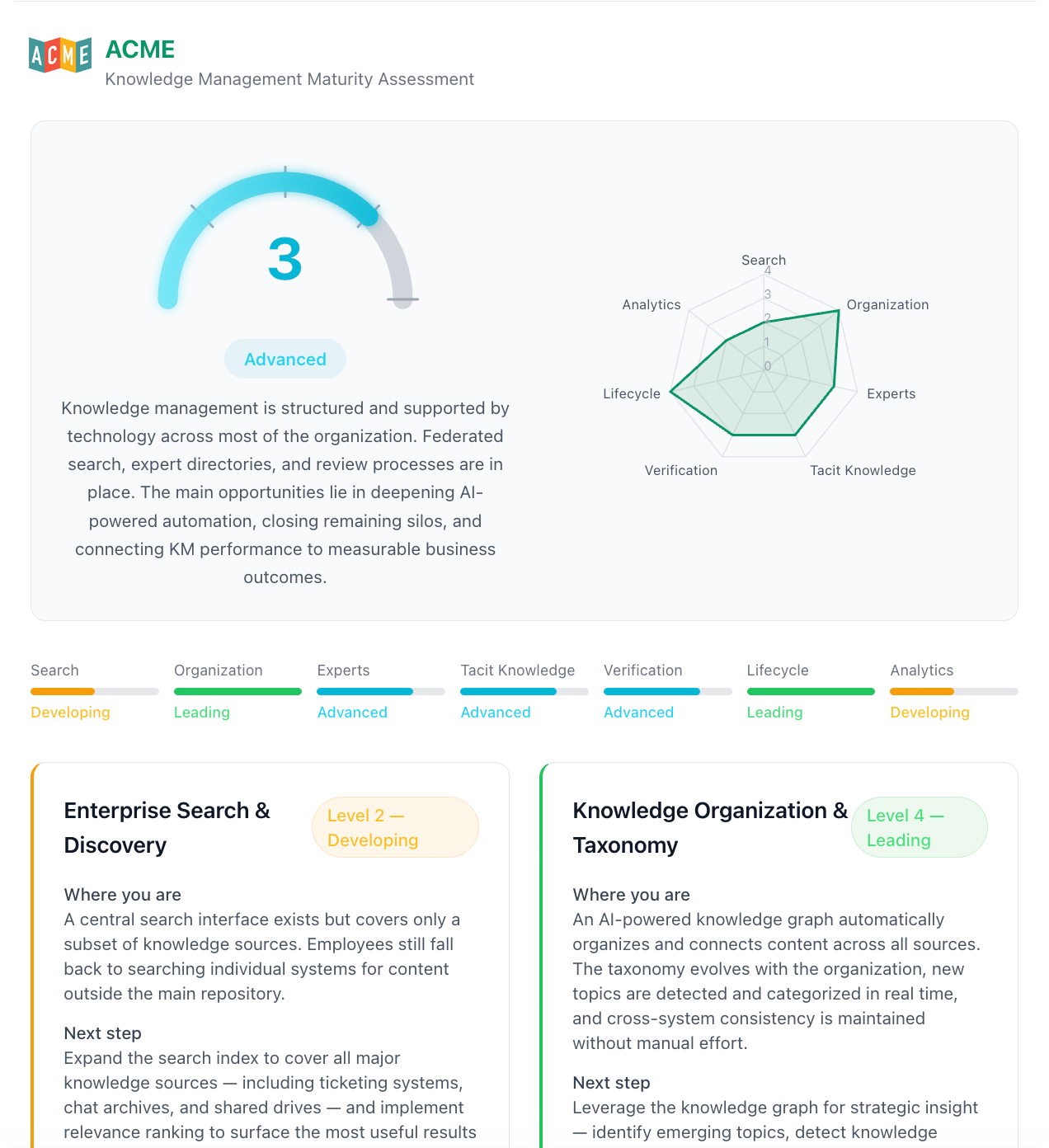
Individual scores for each of the 7 dimensions with visual radar chart
A ‘where you are’ snapshot for each dimension based on the score
Concrete ‘next step’ recommendations to advance each dimension
Business impact projections showing what each improvement unlocks
Learn how leading organizations manage knowledge
The assessment is part of a broader framework. These articles explore how knowledge management evolves in practice, where organizations get stuck, and how successful teams move from scattered information to unified, actionable intelligence.
When Most of Your Team Is New: How to Preserve Institutional Knowledge at Scale
High turnover doesn't have to mean knowledge loss. Learn how organizations keep institutional expertise alive even when the majority of the workforce is relatively new.
Read more →Tacit Knowledge: The Most Valuable Asset You're Probably Not Managing
The expertise that lives in people's heads — not in documents — is often the most critical knowledge in an organization. Here's why it's so hard to capture, and what actually works.
Read more →Why Knowledge Gaps Cost More Than You Think — and How to Find Them
Most organizations don't discover knowledge gaps until something breaks. A proactive approach to gap detection can prevent costly delays, duplicated effort, and missed opportunities.
Read more →